


Building the Modern Credit Workforce

What skills do credit professionals need as AI, data, regulation and sustainability reshape the credit workforce? New GICP research analyzes more than 1,500 live job postings from the world’s top 50 banks to reveal the capabilities employers now prioritize across credit risk, credit analysis, underwriting, portfolio management, relationship banking, markets, data and product roles.
‘Building the Modern Credit Workforce’ shows that employers are converging around a durable blend of credit skills. These key skills are: data governance, model risk oversight, regulatory fluency, AI awareness, NLP and document analysis, risk judgment, communication, adaptability, stakeholder management and commercial decision-making.
Download the report to explore the findings in detail and see how skill demand shifts across functions, seniority levels, and credit role types.
The Market Is Converging Around a Shared Credit Skill Set
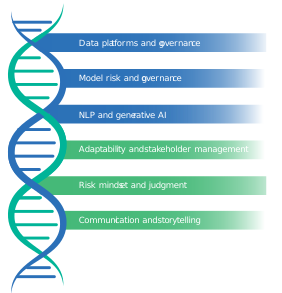
The research shows that today’s credit professional shares a common ‘DNA’. Credit capability is no longer defined by technical knowledge alone, but by the ability to connect data, models, regulation, judgment and communication into decisions that can be explained and defended.
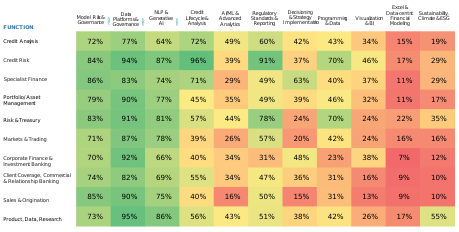
Technical Skill Demand Varies by Function.
While a shared core skill set is visible across the market, technical requirements vary by function.
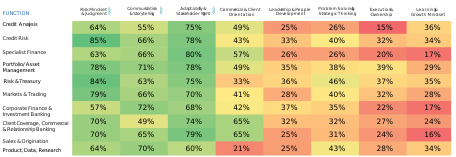
Behavioral Skills Are Core Risk Capabilities
The research also shows that behavioral skills are central to credit accountability. Risk mindset, communication, adaptability and stakeholder management appear consistently across job postings because credit decisions must be interpreted, challenged, defended and acted on.
 Career Progression Changes the Skill Mix
Skill demand also changes as careers progress. Junior and mid-level roles emphasize reliable analysis, data quality, model governance, regulatory awareness and clear communication. Manager and VP roles require stronger decision ownership, stakeholder influence, leadership and commercial judgment. At director and senior leader level, the emphasis shifts toward strategy, governance, leadership, risk appetite and enterprise accountability. Below is an example of a roadmap for mid-career professionals. The report includes roadmaps for junior professionals and senior executives, drawing on the data from the job postings.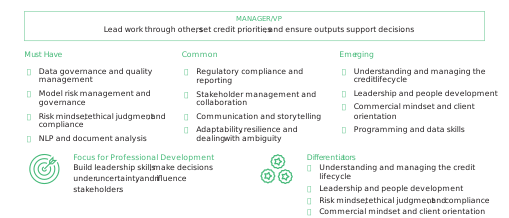
Why Credit Skills Are Changing Now
Credit teams are operating in a more complex environment: larger data volumes, tighter regulation, greater scrutiny, faster decision cycles, expanding AI use and rising demand for sustainability-related analysis. The report shows that the most valuable credit professionals will not be defined by one tool or technical specialty. They will be the people who can connect credit fundamentals, data, models, judgment and communication into decisions that stand up under pressure.
Frequently Asked Questions
What skills do credit professionals need most?
Credit professionals need a combination of credit analysis, data governance, model risk oversight, regulatory understanding, AI awareness, risk judgment, communication and stakeholder management. The report shows that these skills now appear consistently across credit roles and seniority levels.
Is AI replacing credit professionals?
No. The research shows that AI is being embedded into credit workflows to support analysis, document review, decisioning and workflow efficiency. However, employers still expect credit professionals to own judgment, governance, challenge, documentation and accountability.
Which credit roles are becoming more hybrid?
Hybrid credit roles are most common in areas closest to data, models and repeatable decision processes, including underwriting, credit research, data and modeling, product roles and some risk management functions.
Why do behavioral skills matter in credit?
Behavioral skills matter because credit decisions must be explained, challenged, defended and acted on. Communication, risk mindset, adaptability, stakeholder management and commercial judgment help professionals turn technical analysis into credible credit decisions.
How can credit professionals prepare for the future of credit work?
Credit professionals can prepare by strengthening core credit fundamentals, improving data and AI fluency, understanding model governance and regulation, and developing the communication and judgment skills needed to operate in more complex credit environments.
From Insight to Action
Modern credit skills are shifting. The professionals who lead the next chapter will be those who invest early in the capabilities that endure: credit fundamentals, risk judgment, data fluency, AI awareness, model governance and clear communication.
GICP learning pathways are designed around the capabilities employers consistently prioritize, helping professionals strengthen core skills and progress with confidence.
The Global Credit Certificate prepares professionals for the future of credit work, including private credit, covenant discipline, sponsor behavior and AI early warnings — all grounded in credit fundamentals and rigorous cases.
You may also be interested in these courses delivered in partnership with Fitch Learning.
- Fundamentals of Data Analytics with Python
- Excel for Financial Professionals
- Certificate in Financial Modeling
- Certificate: Risk Management in Banks
- ESG Impact on Credit
Further GICP Resources
- Credit in the Age of AI – research on AI adoption, impact, governance and workforce change
- Careers in Credit – practical guidance on credit roles, hiring trends, skills and career progression
- A Guide to Careers in Credit — a guide to career paths, role profiles, key skills and salary benchmarks
- How AI Is Transforming Credit Analysis – how AI is reshaping the credit function and how to use it responsibly