


Private Credit Capability Under Pressure

Private credit is expanding into larger, more complex deals. But as products become more sophisticated and execution expectations rise, many firms face a growing challenge: capability depth.
Based on research with private credit professionals, this report explores where teams are strongest, where capability gaps are emerging, and whether the workforce is prepared for the next phase of market growth.
Download the report to explore the findings in detail and see where emerging skills and capability gaps could create real risks for the future of private credit.
Key Findings
The research highlights capability as a strategic constraint.
- Teams are broadly ‘competent’, but few have the advanced expertise needed for greater complexity.
- Firms are moving into more sophisticated products faster than skills and expertise can keep up.
- Execution depth is limited, creating risks to speed, control and scalability.
- Weak analyst capability increases the likelihood of preventable errors and losses.
Private Credit has a Capability Problem
The issue is often not access to talent, but the depth of capability within existing teams. While most professionals are comfortable with traditional credit analysis and familiar lending structures, far fewer demonstrate advanced expertise in structuring, portfolio monitoring, execution, modeling, negotiation, and emerging private credit strategies.
As private credit grows more complex, competence may no longer be enough.

Execution Capability is Becoming a Competitive Advantage
The research suggests many firms have strong foundations but insufficient depth in key areas, creating a gap between strategic ambition and operational readiness.
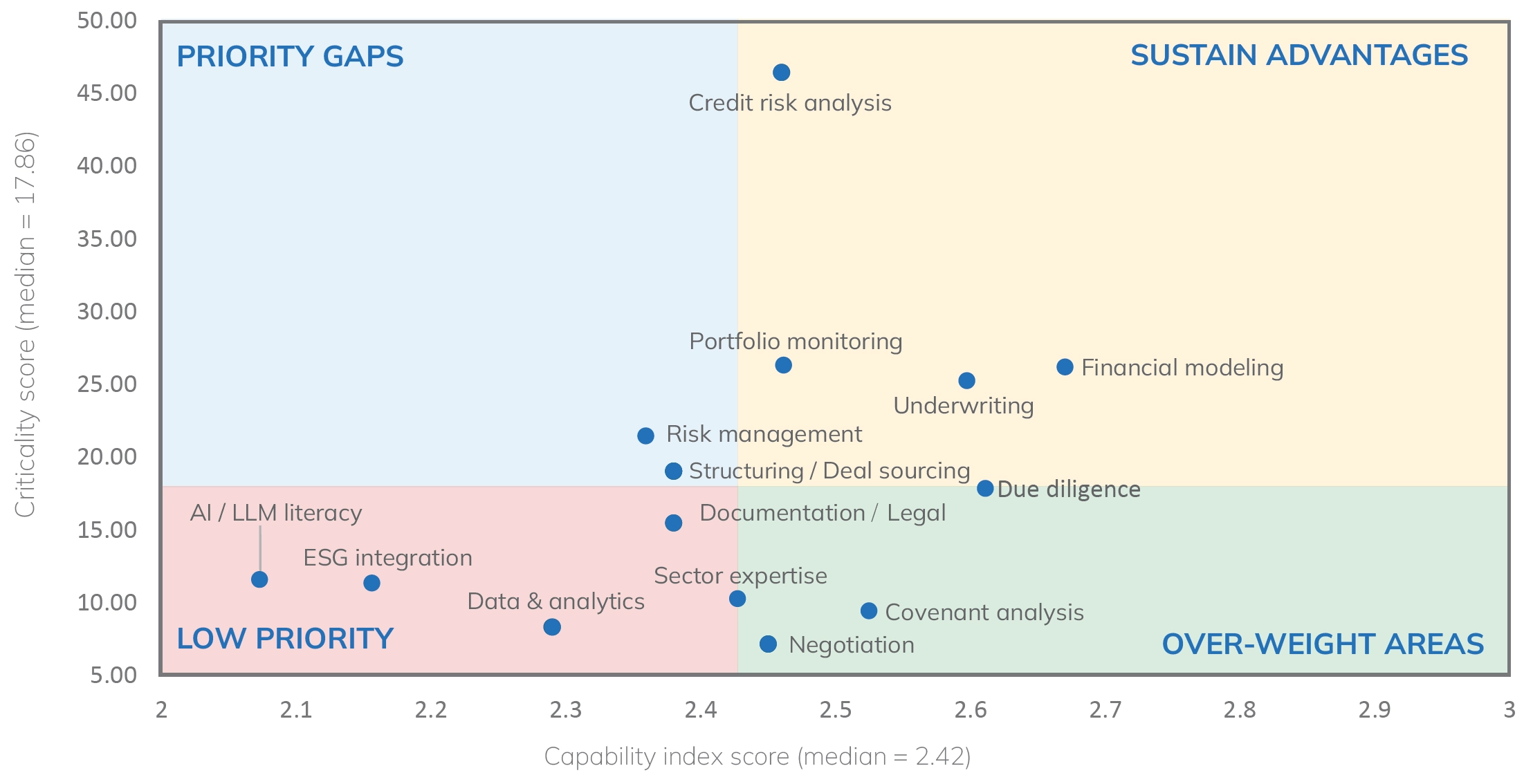
The Next Generation of Private Credit Skills
The most important future capabilities extend beyond traditional credit analysis.
These capabilities are becoming increasingly important in specialized private credit roles as the market expands into more sophisticated financing solutions.
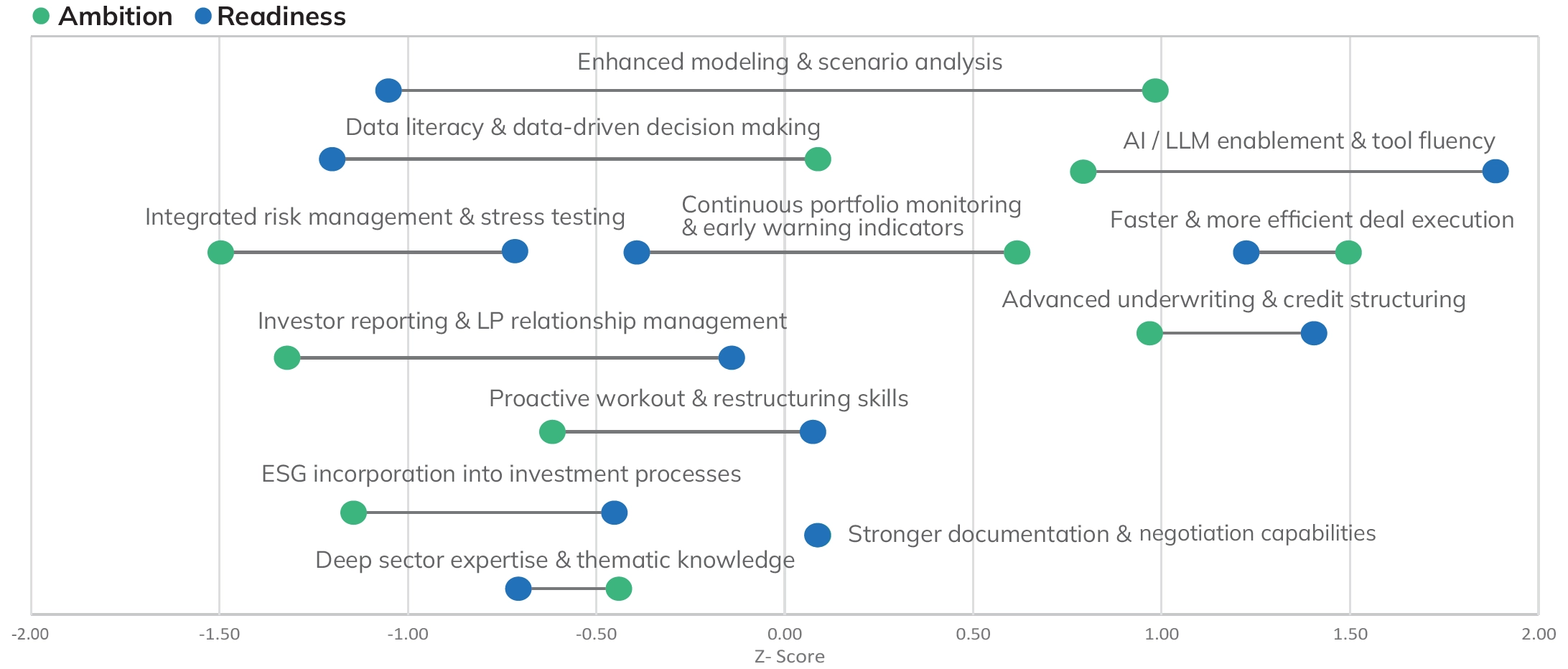
What Skills are Needed for a Career in Private Credit?
Private credit professionals require strong credit analysis, underwriting, financial modeling, risk management, and portfolio monitoring skills. Increasingly, firms are also seeking expertise in structuring, data analytics, AI literacy, and workflow execution.
What are the Biggest Capability Gaps in Private Credit?
The research identifies capability gaps in execution, structuring, sourcing, portfolio monitoring, financial modeling, data analytics, and emerging private credit products.
Why is Talent Important in Private Credit?
As deal structures become more complex and competitive pressure increases, firms need deeper expertise to manage risk, maintain consistency, and scale effectively.
How Can Firms Strengthen Private Credit Capability?
Organizations can improve capability through practical training, live deal exposure, structured development pathways, technology enablement, and investment in specialist expertise.
Build Private Credit Capability with the Global Credit Certificate
As private credit grows and technology reshapes the credit lifecycle, this research shows that professionals increasingly need expertise that goes beyond traditional credit analysis. The skills identified in the report align closely with the capabilities developed through the Global Credit Certificate (GCC).
The GCC provides dedicated coverage of both private credit and AI. The program offers practical training across credit analysis, financial statement interpretation, financial modeling, risk assessment, decision-making, portfolio monitoring, and AI-enabled credit workflows, helping candidates to develop the capabilities needed for the future of private credit.
Visit our Global Credit Certificate page for more information.